
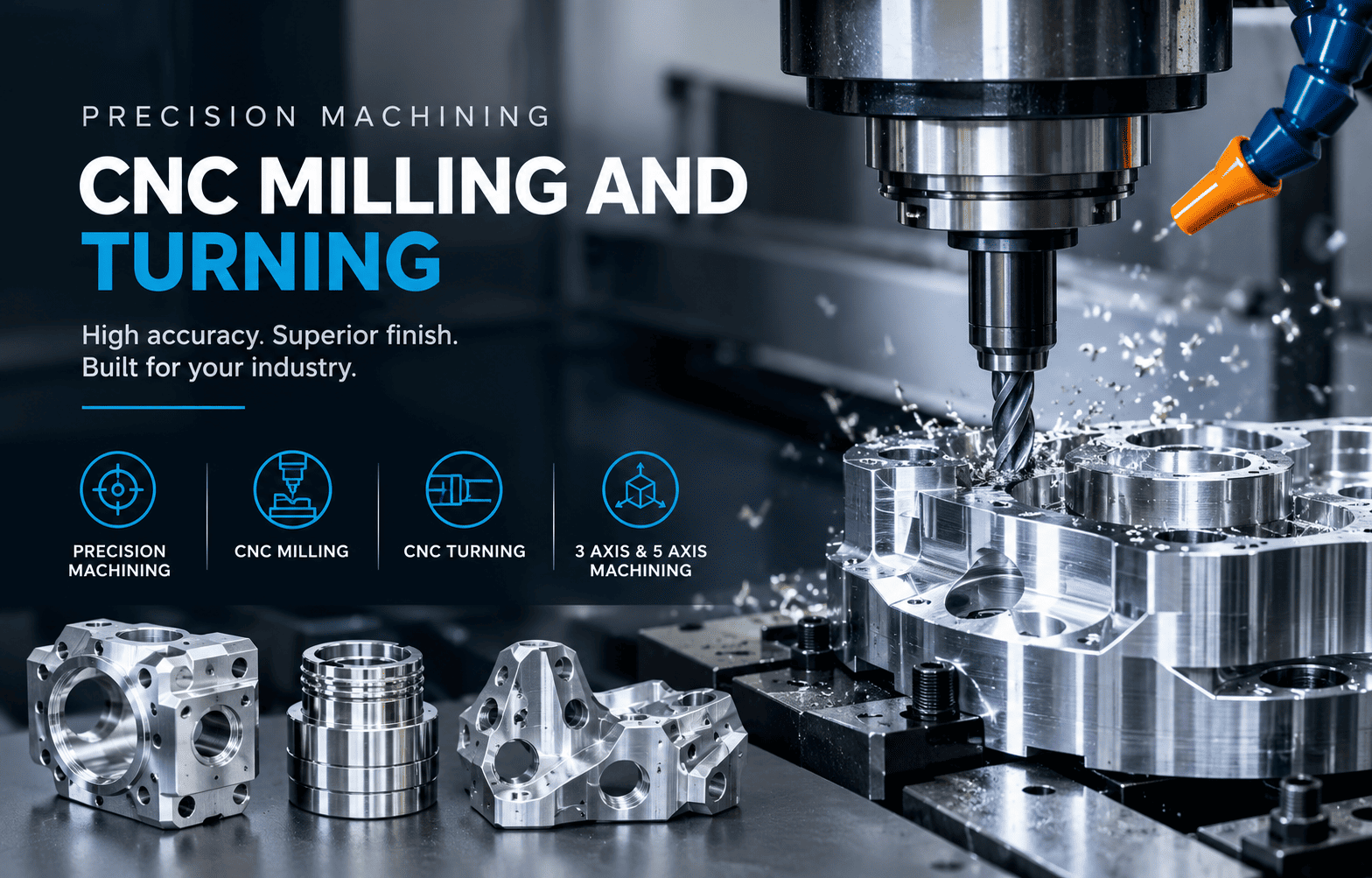
# In today’s manufacturing industry, precision, reliability and efficiency are essential for producing high-quality engineering components. From custom machine parts to complex moulds and tooling, modern machining technologies help manufacturers achieve accurate dimensions, consistent quality and dependable performance.
**Precision machining, CNC milling and turning, and 3-axis and 5-axis machining** are important processes for manufacturing components that meet demanding engineering specifications. By choosing the right machining technology and working with an experienced engineering team, businesses can improve manufacturing efficiency and achieve reliable results.
Prime Tooling is an Australian-owned precision toolmaking and engineering company based in Kings Park, New South Wales, providing machining, tooling, design and prototyping services.
## What Is Precision Machining?
Precision machining is a manufacturing process that removes material from a workpiece to create a component with specific dimensions, shapes and surface finishes. Computer Numerical Control (CNC) technology uses programmed instructions to control machining operations, helping produce components accurately and consistently.
Precision machining is widely used in engineering and manufacturing applications where components must fit correctly, operate reliably and meet defined design requirements.
Common applications include:
– Engineering components and machine parts
– Injection moulds and mould inserts
– Jigs, fixtures and specialised tooling
– Custom-designed mechanical components
– Prototype parts and product development
– Industrial manufacturing equipment
Careful planning, suitable tooling, accurate programming and appropriate inspection methods all contribute to successful precision machining.
## CNC Milling for Accurate Engineering Components
CNC milling is a machining process that uses rotating cutting tools to remove material from a workpiece. It can produce a variety of features, including slots, pockets, holes, flat surfaces and complex contours.
**Precision CNC milling** is particularly useful for manufacturing engineering parts and tooling components that require accurate geometry and repeatable dimensions.
The process generally begins with an engineering drawing or a computer-aided design (CAD) model. Computer-aided manufacturing (CAM) software can then be used to develop toolpaths that guide the CNC machine during production.
Key applications of CNC milling include:
– Manufacturing mould plates and inserts
– Producing machine components
– Creating precision fixtures and tooling
– Machining prototypes and custom parts
– Manufacturing components with detailed profiles
Selecting the appropriate cutting tools, machining strategy and workholding method helps achieve the required specifications while making production more efficient.
## CNC Turning for Cylindrical and Rotational Parts
CNC turning is another important process in precision machining. Unlike milling, turning typically involves rotating the workpiece while a cutting tool removes material to produce the desired shape.
This method is suitable for manufacturing components with cylindrical or rotational features, such as shafts, pins, bushes, sleeves and spacers.
Precision CNC turning helps manufacturers maintain consistent diameters, grooves, shoulders and other features according to engineering drawings.
For components that require both milled and turned features, combining machining processes can provide a practical manufacturing solution. The most appropriate approach depends on the part’s geometry, material, tolerances and intended application.
## Understanding 3-Axis CNC Machining
3-axis CNC machining operates along three primary linear axes: X, Y and Z. This configuration is widely used for producing components with straightforward geometries and machining features that can be accessed from suitable directions.
Three-axis machining can be an effective choice for many standard engineering and toolmaking applications.
Typical applications include:
– Flat surfaces and profiles
– Slots, pockets and drilled holes
– Mould plates and tooling blocks
– General engineering components
– Fixtures and prototype parts
One of the main advantages of 3-axis machining is its suitability for a wide range of conventional milling operations. When a component does not require complex multi-angle machining, this method can provide an efficient and economical manufacturing option.
## What Is 5-Axis CNC Machining?
5-axis CNC machining adds two rotational axes to the three primary linear axes. This additional movement allows the cutting tool or workpiece to be positioned at different angles during machining.
The technology is particularly valuable for producing components with complex geometries, angled surfaces, curved profiles and features that are difficult to access using conventional machining methods.
Potential benefits of 5-axis machining include:
– Greater flexibility when machining complex components
– Access to multiple surfaces with fewer setups
– Reduced need for repeated component repositioning in suitable applications
– Improved consistency between features when setups are reduced
– More efficient machining of intricate shapes
For precision toolmaking, 5-axis machining can be particularly useful when manufacturing complex mould components and engineered parts with demanding geometric requirements.
The suitability of this process depends on the component design, machine capabilities, tolerances and production objectives.
## 3-Axis vs 5-Axis Machining: Which Is Right for Your Project?
Choosing between 3-axis and 5-axis machining depends on the complexity of the component and its manufacturing requirements. Both methods offer advantages when applied to the right type of project.
**3-axis machining** is generally suitable for components with accessible surfaces, standard milling features and relatively straightforward geometries. It can be a cost-effective choice for many engineering parts and tooling applications.
**5-axis machining** is often more suitable for complex components requiring machining at multiple angles, intricate contours or access to several surfaces. Reducing the number of setups can help improve consistency and manufacturing efficiency.
Before selecting a machining method, manufacturers should consider:
– Component geometry and design complexity
– Required dimensional tolerances
– Material type and machining characteristics
– Surface finish requirements
– Production quantities
– Machining time and overall project cost
Evaluating these factors early helps identify a suitable manufacturing approach and avoid unnecessary machining operations.
## The Importance of Precision Machining in Toolmaking
Precision machining plays a significant role in toolmaking, particularly in the production of injection moulds, tooling inserts, jigs and fixtures.
These components must be manufactured according to their design specifications to support correct assembly and reliable operation. Small dimensional variations can affect component fit, mould performance and the quality of finished products.
Combining engineering design, CAD modelling, CNC machining and suitable inspection procedures helps manufacturers address potential issues throughout the production process.
For businesses developing new products or maintaining existing tooling, precision machining can support prototype development, tooling modifications, replacement components and specialised engineering requirements.
## How CNC Machining Supports Prototyping and Product Development
Before moving into full-scale manufacturing, businesses often need prototypes to evaluate a product’s design, dimensions, functionality and assembly.
CNC machining can turn CAD designs into physical components, allowing engineers to assess whether a part meets its intended requirements. Design adjustments can then be made before committing to larger production runs or final tooling.
This approach is valuable for custom engineering parts, mould components, fixtures and product development projects.
Prime Tooling offers services that include individual parts machining and assembly, parts machining and fabrication, prototype moulds and low-volume moulding. These capabilities can support businesses requiring practical engineering and manufacturing solutions.
## Why Choose Prime Tooling for Precision Machining?
Selecting an experienced machining and toolmaking provider is important when component accuracy, design requirements and production quality matter.
Prime Tooling is an Australian-owned precision toolmaking and engineering company established in 1999. Based in Kings Park, NSW, the company provides services covering CNC machining, precision milling and turning, product design, 3D CAD modelling, prototyping and tool manufacturing.
Its broader capabilities include injection moulds, jigs and fixtures, mould modification, and maintenance and repair work.
By considering each project’s design, tooling and machining requirements, Prime Tooling supports manufacturing needs across a range of engineering applications.
To learn more about its services, visit [Prime Tooling](https://www.primetooling.com.au/).
## Conclusion
Precision machining is essential for manufacturing accurate, reliable and high-quality engineering components. CNC milling and turning provide versatile solutions for different part geometries, while 3-axis and 5-axis machining offer different levels of flexibility depending on component complexity.
Understanding these processes helps businesses select appropriate machining methods, manage manufacturing requirements and achieve consistent results.
For companies seeking precision machining, CNC milling and turning, or engineering support for tooling and prototype development, Prime Tooling provides a range of manufacturing services tailored to project requirements.
**Looking for precision machining solutions in Australia?** Contact Prime Tooling to discuss your engineering components, tooling or prototyping requirements.
—
**SEO Title:** Precision Machining, CNC Milling and Turning | Prime Tooling
**Meta Description:** Discover precision machining, CNC milling and turning, and 3-axis and 5-axis machining for engineering components, tooling and prototypes with Prime Tooling.
**Focus Keywords:** Precision machining, CNC milling and turning, 3-axis machining, 5-axis machining
**Suggested URL Slug:** `precision-machining-cnc-milling-turning-3-axis-5-axis`
**Suggested Image Alt Text:** Precision machining of engineering components using CNC milling and multi-axis machining technology.